By S. J. Peters, Executive Director, PCA of Greater Chicago
Three information-packed sessions presented by the Union Affiliated Contractors (UAC, a PHCC Enhanced Service Group) on Oct. 29 drew strong attendance at PHCC’s CONNECT convention late last month in Grand Rapids, Michigan. The sessions focused on the unique issues, challenges, and opportunities impacting signatory (union) plumbing and HVAC contractors
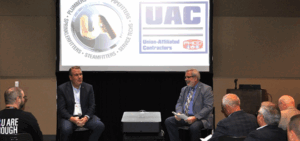
The “centerpiece” session, a “Conversation with UA General President Mark McManus,” opened with the keynote speaker delivering a concise overview of the 393,000-member international union’s current projects and activities – including training initiatives; organizing (recruitment) successes; legislative, code, licensing and regulatory priorities; and specific programs and initiatives that are underway and being led by the UA’s various departments.
UA General President Mark McManus responded candidly yet thoughtfully to questions posed from nearly 75 attendees and led by moderator S. J. Peters (PCA-Chicago and UAC) at this briskly paced 80-minute session, covering a number of pertinent topics.
Whether commenting on the UA’s consistent efforts to protect licensing and strong codes; gaining (and regaining) work endlessly pursued by other trades or unlicensed “posers;” explaining the union’s strategies for ongoing growth and evolution; innovations launched by local unions that often are adopted throughout the UA; or the cutting-edge technological and end-user oriented training the UA insists on, McManus repeatedly emphasized the long-standing and industry-focused collaboration between the contractors and the union’s leaders and members.
Attendees were treated to a substantial and spirited discussion, often peppered with humor as well as personal insights by both the speaker and an audience comprised of contractors (signatory and “open shop”), association officials, union leaders, and CONNECT registrants from many areas of the trade who came to listen in.
Pension Plan Options: Panel Session – Insights, experiences, and recommendations were sought from five distinct industry leaders who all are well-versed on the main subject of Defined Benefit union pensions in this substantial examination of the viability, sustainability, and the future of retirement plans in the multi-employer world.
Under the direction of moderator S. J. Peters (PCA and UAC), Plumbers Local 130/Chicago management co-chair Michael Kerrigan (FJ Kerrigan Plumbing) recounted the prudent actions over the past decade that led to the current nearly 106% funding of its DB plan, while MCA/PHCC Detroit EVP Chris Freeman explained how both Plumbers Local 98 and Pipefitters Local 636 in that market agreed to switch to an innovative “Cash Balance” plan aimed at preserving retirement security for the members.
Immediate past PHCC President Dan Callies (Oak Creek Plumbing) commented on the funding levels and participant perceptions on the retirement plan at Plumbers Local 75 covering a large section of Wisconsin, while past PHCC president and current UAC chairman Dave Frame (Bob Frame Plumbing Services, South Bend IN) offered his perspectives as a previous DB plan Trustee for UA Local 72.
Attorney Christina Wernick, partner with Laner-Muchin/Chicago and previous counsel for the Laborers Union in Greater Chicago, delved into issues and resolutions she has dealt with and observed regarding national pension plans, the PBGC, plan mergers and their impact (positive or otherwise), the “rescue plan” (realities vs. perceptions), and more. Audience participation added to a substantial exploration and a constructive discussion on this crucial topic.
Selling; Next Generation Transitioning; or Closing a Union Contracting Business – Attorney/Of Counsel Megan Wilkes along with Attorney/Partner Christina Wernick of Laner Muchin/Chicago jointly presented this in-depth session (“Eyes Wide Open”) offering advance advice and important considerations that apply specifically to union contractors as they plan to leave their businesses. Among the subjects covered: collective bargaining contract language “binding” the companies to a union; how to properly disassociate or transfer such relationships; pension fund obligations to be addressed prior to a transition; and recommendations on avoiding pitfalls and problems that may arise without prudent planning. The session leaders also fielded many relevant audience comments and questions.